Showing posts with label Writing. Show all posts

Friday, September 25, 2009

Tips for Quick Grading Written Work

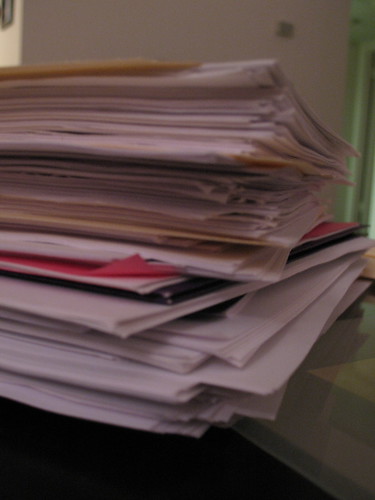
As we approach midterms (I know, already!), you may be testing out those red pens, doing wrist-strengthening exercises, and stocking up on chocolate-covered double-espresso beans to help get you through the grading that is to come.

But grading doesn't have to be this way. Really.

So how can you reduce the time and energy required to grade? I'm concentrating here on written work (lab reports, essay exams, thought papers), and will focus on other types of assessments in future posts.

1) Have as much written work submitted electronically as possible.

Although some instructors are "old school" about grading by hand, once you get used to reading on the screen and providing type-written comments you'll realize that it's much faster. Other perks: you're saving paper, you have a copy of all of your comments saved to your computer, and students will never complain about your hand writing again!

2) Have a well-defined rubric.

We always recommend not only creating clear grading criteria and weighting of points, but also offering this to students ahead of time. All of my written assignment descriptions are accompanied by the rubric right in the syllabus. On exams, whenever I include multiple-part written answer questions, I am sure to include the point breakdown. This helps students focus their efforts on the most important points, and actually leads to better formulated responses. When it comes time to grade, you can convert your rubric into a checklist and simply go down the list. Students are less likely to be confused about why they earned the grade they did, and you've sped up your grading time considerably.

Never created a rubric before? Come to us for guidance. Or try RubiStar, where you can create your own rubrics for free.

Bonus points: Pair this tip with the previous one and complete and return all of your rubrics electronically.

3) Create "canned" feedback.

This is an ingenious tip from Darrell Coleman, Assistant Director of the Center for Teaching & Learning Excellence.

Have you ever noticed as you grade that students always seem to have trouble with the exact same concepts? There are always patterns in the errors students make; the same confusions appear from semester to semester. So why should you have to respond each and every time the same mistake is made? Well, you don't.

If you create a document with all of the comments you make the first time you grade an assignment, you can simply go back to that document and cut and paste each time you need to make the same comment again. Brilliant!

What are your time-saving tips for grading written work? We'd love to hear them!


Photo by

Friday, February 20, 2009

Teaching ESL Students to Write

After my last post about writing, I received a message from Zuzana Tomas, a graduate student and instructor in Linguistics. She suggested that I share with you some information about the ESL Writing Initiative. According to their website, "The ESL Writing Initiative exists to provide accessible information to faculty members and instructors about how to teach, assign, and respond to the writing of students of English as a second language ("ESL students") across the U."

Although most of us support efforts to increase diversity in the classroom, we may not always be sufficiently prepared to adapt our teaching to the diverse set of abilities and needs that our students bring with them. In Fall 2008, 7% (or nearly 2000 U of U students) were identified as International Students, many of whom speak English as a second language. Furthermore, because of the diversity within the US, we would be naive to assume that all of our domestic students are native English speakers. Neverthless, the majority of our classes our conducted entirely in English.

Can you imagine how difficult it would be to try to master a subject at the college level in a language with which you are not entirely familiar? This is the position many of our students are in, so we as instructors need to find ways to help them strive towards the same high standards to which we hold other students. Perhaps not surprisingly, you'll find that many of the techniques used to help support the learning of ESL students can also help native English speakers as well.

Do you provide both written and oral instructions when giving an assignment? Do you ask a colleague to review your assignment to make sure the instructions are clear? Do you provide models, perhaps through the use of student examples?

These are just some of the tips provided by the ESL Writing Initiative. What else have you done in your class to support ESL students in their writing?

Did you know?

Students appreciate having examples of past student work. These examples are most effective if you've included your comments and grading along with the example. Just be sure to ask for permission before using a student's paper as an example, and to create written assignments that discourage copying the example (e.g., require students to analyze a different case than in the original paper, or incorporate real-life experiences).

Tuesday, February 17, 2009

The Minute Paper


Although the candle is likely now replaced by a desk lamp with an energy-saving bulb, the espresso with an energy drink, and the pen and paper with a laptop, staring at a blank page in the middle of the night has likely been a familiar, and dreaded, experience for college students of any era. How can we help our students avoid this predicament?

One way is to integrate low-pressure writing assignments into your course. The "Minute Paper" is a great example. This is likely the most commonly used classroom assessment technique (Angelo & Cross, 1993). Typically the way it is used is to ask students a question (e.g., What was the most important point from lecture today?, What is the main achievement of the first stage of Piaget's theory of cognitive development and what new skills does this achievement support?), and provide them with one minute to write their answers on a scrap of paper. Some instructors ask students to write their names on the papers and count them towards class participation, but the most common practice is to have the papers submitted anonymously.

Typically, the main benefit of this exercise that is discussed is that it allows instructors to quickly assess student understanding. Even in large classes, the Minute Paper allows you to see how many students "got it", and perhaps what details you need to review. This approach is also useful for collecting quick feedback about group work or the use of a new technique.

An additional benefit to the Minute Paper is that you are encouraging students to write. Used often, this exercise provides practice in getting ideas down on the page in a limited amount of time. This could help student performance on essay exams and in other written work, as there will be less time spent staring at a blank page and more time writing down ideas.

One caveat to the use of the Minute Paper is that if you use them frequently but do not respond to what students have written, students may take them less seriously, thus making the exercise less useful (both for you and for your students).

Resource: Angelo, T. A. & Cross, K. P. (1993). Classroom assessment techniques: A handbook for college teachers (2nd ed.). San Francisco: Jossey-Bass.